
Bringing in someone with previous experience, whether a clerk or operator, a lean specialist or a senior lean manager, can certainly benefit the organisation. Depending on grade and role, of course, the positive effect of people already involved in continuous improvement will vary in scale. With the right sponsorship and the right experience, getting started will still be an uphill climb, but a less steep one; there are, however, some weaknesses and threats that can affect, above all, how quickly results are achieved.
- In-house staff are often constrained by hierarchies and by how freely they can move across company functions; indeed, many companies are organised in silos, each with its own boundaries and areas of expertise. This is a limitation for anyone focused on the value stream, which inevitably crosses functional boundaries. It often also means being limited in generating results for the organisation, and therefore being unable to deliver significant results to the bottom line. Working outwards “like ripples in a pond” and spreading lean culture to colleagues and the organisation is a mission that takes time and money, which the company cannot always afford.
- Choosing the right person to manage change is not easy, because selecting a competent professional itself requires a certain level of expertise. The skills of the ideal candidate are hard to pin down: you need someone who is highly technical, with strong empathy, a big-picture view and a great ability to synthesise.
- Another issue, as thorny as it is debated, is resistance to change, which is inevitable in every attempt at improvement. People often tend to take out on the change agent the frustration that comes from leaving their comfort zone; the unfortunate individual goes from being a facilitator to the scapegoat for every ill. For this reason – and it often happens – the internal staff who live with this blame game every day are the very ones who end up frustrated in their work, and so they lose effectiveness. The most serious consequences for the business are predictable: money has been invested in people with no benefit and with potential left untapped. Here too, the flexibility of a consulting firm has its advantages, including the ability to scale the intensity or frequency of the engagement up or down and to draw on professionals who are highly specialised or, as in Inproov’s case, multidisciplinary.
The Inproov model: a process for change
In the cases we have handled across different sectors, we find that business owners and managers feel the need for outside advice before embarking on major restructuring projects. Indeed, it is essential to follow a process that ensures the greatest effectiveness and efficiency when setting out on a lean transformation journey for the company.
According to the Assoconsult observatory for the past two years, more and more companies have turned to consulting firms to manage change and corporate strategy, with the value of services sold expected to grow by 9.7% in 2022; this positive trend reflects the trust placed in the profession. Choosing an “outside” expert is an increasingly common path; however, to prevent that expert from taking the place of collective improvement and acting as a Deus ex machina, it is wise to follow a process rather than gut feeling.
Our experience confirms that, to guarantee the expected results, it is essential to respect certain stages of development, each with its own inputs and outputs, timescales, indicators and SMART objectives. Our proposal is built on an analytical approach that moves from the macro level down to the finest detail, with a strong focus on the causes of economic and financial loss for the client.
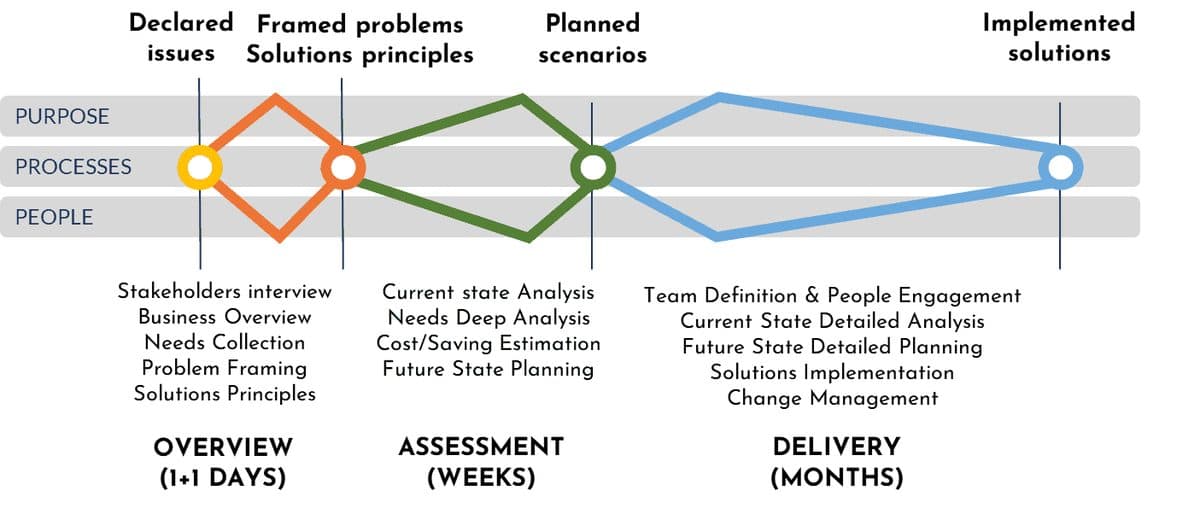
Only by starting from an assessment do we develop a diagnosis and turn it into a cure: a project for which we can estimate costs and benefits before taking action.
This process is aligned with PDCA logic, in which “thinking” comes before “doing”, and that thinking sets priorities based on the company’s financial statements rather than on gut feeling.
Sometimes we are driven by instinct, only to discover that the problems lie elsewhere, and often we cannot see this without outside intervention and help. We spend energy and time on activities that we may even be pleased with, but that are neither relevant nor solve the root causes of the business’s problems.
In conclusion, choosing to act only after an in-depth, objective external analysis means turning to a consultant; this does not rule out bringing in an internal person at a later stage, sometimes during the implementation phase of the project.