
The context: speed matters
To describe the business world, and at times the context we live in, the acronym V.U.C.A is often used: Volatility, Uncertainty, Complexity, Ambiguity. The acronym has military origins in the 1980s and was later recycled in a broader sense in the decades that followed. Jack Welch, CEO and chairman of General Electric between 1981 and 2001, famously said on the subject: “If the rate of change on the outside exceeds the rate of change on the inside, the end is near.”
So the point is this: if you do not change paradigms at a pace that keeps up with the market, you lose hold of the reins.
Volatility, uncertainty, complexity and ambiguity do not stop us from planning; rather, they should make us stop and think: if everything is chaotic and in motion, the only option left is to face change with vision, understanding, courage and flexibility; making decisions that let us steer towards a chosen direction, instead of letting ourselves be carried along, therefore becomes a necessity for managers and entrepreneurs, regardless of sector, size or any other factor.
As Cicero wrote: “Nihil inimico quam sibe ipse”, which translates as “Nothing is more dangerous than oneself”. The choice to improve is in our hands.
First kaikaku, then kaizen
Improvement can come about through different approaches. Staying on the path laid out and shaped by the Toyota experience, the best known and most sought after is kaizen (often translated as, and known as, continuous improvement), which follows a bottom-up logic and calls for a disposition towards gradual, lasting and never-ending self-improvement.
Applying kaizen stands in contrast to improvement through “reform”, that is, through a single event that radically changes the current situation, known as kaikaku, which follows a top down logic.
The perception that the kaizen model can always be pursued and delivers exceptional results is borne out by a plethora of examples; it is undoubtedly a virtuous model, and one worth pursuing, but it must be:
- Guided
- Planned when the time is ripe
The two models should be seen as complementary, not as opposites. Both are valid and applicable when approaching a company of a distinctly Fordist-Taylorist kind, but in an organisation that wants to change by following the TPS model (Toyota Production System), the path of continuous improvement alone, without a moment of rupture with its legacy, is not viable. It must also be said that not every company can afford the luxury, or the time, of retracing in small steps all the stages its competitors have already been through. Emulating the operational excellence already found in other markets is also, at times, a risky mission: you do not know the starting context, nor what drive struck the spark.
“Immature poets imitate, mature poets steal. Bad poets deface what they take, and good poets make it into something better, or at least something different”. T.S. Eliot
Reforming with method
A consultant adds real value if they manage to create a break and bring in a new model with fast, significant results for the business; only then does it become necessary to trigger continuous improvement as a cultural practice, and only then does it make sense to invest in internal resources that help sustain it.
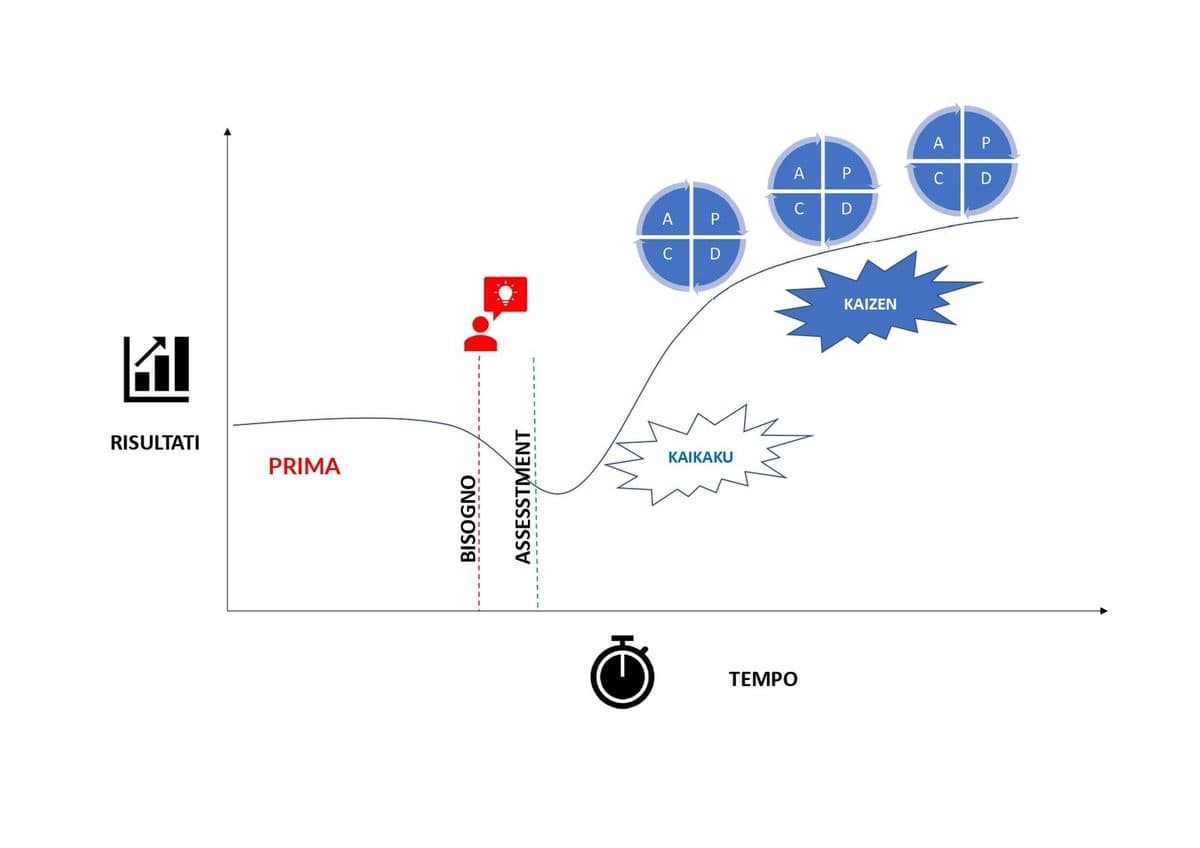
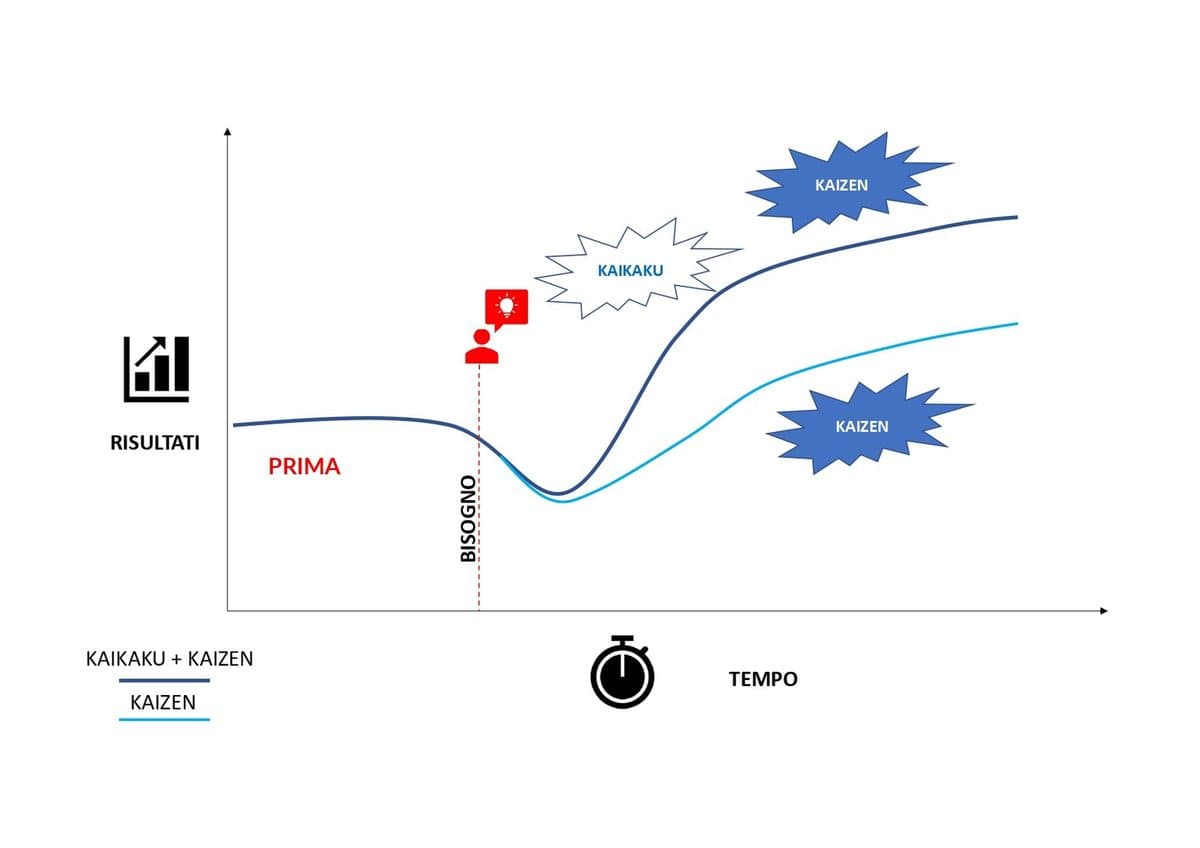
The Deming cycle, known as PDCA, short for Plan, Do, Check, Act, should be seen as a turning wheel. This representation fits every organisation we have dealt with; the picture becomes complete once the effect of kaikaku is added.
Without a moment of initial reform, the effect of continuous improvement will be slow to materialise and the expected results will be harder to achieve.
Involving people in the thinking, not in “stopgap” fixes
In every (I dare say!) training course that deals, even tangentially, with “lean”, two concepts, among many others, will come up:
- Lean = elimination/reduction of waste (muda)
- Involving people
Focusing on muda is not enough. The risk is spending a great deal of energy eliminating defects that have no impact, and setting in motion a transformation process that never delivers tangible results on the ground.
Getting people involved straight away in solving small day-to-day problems is risky. Before embarking on feel-good involvement aimed at fixing every small “standard” defect (I am referring to the 7 wastes framework), you need to be truly aware of the economic and financial impact of the problem you are tackling.
Before starting lean training courses, waste hunting, 5S and all the classic tools, you need to analyse the value, the business, from A to Z.
The Inproov method is based on the PDCA principles in their original form: before acting (Do) and implementing any solution, you need to understand, with an ABC logic, how much that problem weighs, what impact it has on the income statement, the balance sheet and cash flows, and how long it will take, with the proposed solution, to see the expected results.
People will be involved, because it is right and inevitable, from the very start, to define the vision of “where we want to go”, not to solve the problems of a working system that needs to be rethought. In this scenario, the contribution the team can make will be far more valuable both for its members, who will feel important and therefore more motivated, and for the company.
So: if the business world is V.U.C.A and change is fast and shifting, then you have to change quickly and competently, sometimes through structural reforms that allow clients to be competitive straight away, rather than hoping that, through a slow “ripple effect”, a culture spread by micro-projects will sooner or later reach the place where strategic and structural decisions are made.